

Disaster Preparedness for Retirees: Protect Your Health, Wealth, and Peace of Mind
Quick Answer
Disaster preparedness for retirees goes far beyond an emergency kit. When catastrophe strikes, retirees face unique challenges: disrupted access to healthcare and medications, difficulty accessing retirement funds, vulnerability to disaster-related scams, and extreme emotional toll from losing the stability they worked decades to build. The hard truth is that by the time disaster strikes, it is too late to put protections in place.
Retirees need to prepare across three dimensions: financial safety nets (HELOC, emergency funds, understanding QDRD withdrawal rules), healthcare continuity (medication stockpiles, Medicare contacts, medical equipment replacement), and emotional resilience (support networks, mental health resources, faith community connections). This guide covers what to do before, during, and after a disaster to protect everything you have built.
Key Takeaways
- 1 In federally declared disasters, retirees can withdraw up to $22,000 from retirement accounts through Qualified Disaster Recovery Distributions (QDRDs) without the 10% early withdrawal penalty 1.
- 2 A Home Equity Line of Credit (HELOC) is one of the most overlooked yet crucial financial tools in a disaster plan. Apply while you still have earned income 2.
- 3 Scammers specifically target retirees during disasters because they have accessible emergency funds, are under extreme stress, and may be isolated from their support systems 3.
- 4 Disaster recovery requires a systematic approach across three areas: immediate stability, financial recovery, and emotional resilience.
- 5 Preparation is not just about assets. It is about having systems, contacts, and plans that work when chaos disrupts everything you normally rely on.
Why This Matters
- Disasters do not just damage property. They disrupt access to healthcare, strain finances, and take an emotional toll that can be devastating for retirees living on fixed incomes with limited ability to recover 3.
- The financial consequences of being unprepared can be catastrophic. Retirees who need emergency cash without proper planning may be forced to liquidate investments at a loss, pay unnecessary penalties, or fall victim to scammers offering fast cash.
- Healthcare disruption during disasters is a life-threatening concern for retirees. Dialysis patients need continued treatment, medication-dependent retirees need access to pharmacies, and those with medical equipment need Medicare to replace essential devices.
- Mental health impacts of disaster on retirees are severe and often overlooked. The combination of property loss, financial stress, healthcare disruption, and social isolation can trigger depression, anxiety, and PTSD, especially in those already navigating retirement adjustment.
Key Facts
- Eligible participants in 401(k), 403(b), and 457(b) plans can withdraw up to $22,000 through a Qualified Disaster Recovery Distribution without the 10% early withdrawal penalty 1.
- Enhanced 401(k) disaster loans allow borrowing up to $100,000 or 100% of vested balance, double the usual limit, for 180 days after a disaster declaration 1.
- Most banks still charge penalties for early CD withdrawals even during disasters, typically 60 to 365 days of interest depending on the term 2.
- The IRS extends tax filing deadlines for disaster victims, sometimes by months, and allows disaster losses to be claimed on either the current or prior year return 4.
- Medicare will replace oxygen tanks, prosthetics, and other critical medical equipment lost in disasters. Call 1-800-MEDICARE for immediate assistance 5.
- Fraud targeting disaster survivors costs Americans hundreds of millions annually, with retirees being disproportionately targeted 3.
Accessing Your Money During Disasters
| Option | How It Works | Key Details |
|---|---|---|
| QDRD Withdrawal | Up to $22,000 from 401(k)/403(b)/457(b) without 10% penalty | Must reside in federally declared disaster area with economic losses |
| Enhanced 401(k) Loan | Borrow up to $100,000 or 100% of vested balance | Double the usual limit, available for 180 days after declaration, 1-year repayment delay |
| Bank CD Early Withdrawal | Access CD funds with penalty | Penalties range from 60-365 days of interest. Compare to tax cost of retirement withdrawal. |
| HELOC | Draw from pre-established home equity line | Must be set up before disaster. No cost unless used. Apply while you have earned income. |
| Extended Tax Deadlines | IRS postpones filing and payment deadlines | Can claim disaster losses on current or prior year return, whichever gives better benefit |
Common Disaster Scams Targeting Retirees
| Scam Type | How It Works | How to Protect Yourself |
|---|---|---|
| Fake FEMA representatives | Demand payment for services that are free | FEMA never charges fees. Verify through DisasterAssistance.gov |
| Fraudulent contractors | Require large upfront deposits and disappear | Never pay large deposits. Get local references and verify licenses |
| Fake insurance adjusters | Request personal financial information | Your insurer contacts you. Never share info with unsolicited callers |
| Charity scams | Create fake relief organizations | Verify through Charity Navigator or GuideStar before donating |
| Government impersonators | Promise to expedite assistance for a fee | Government assistance is free. Report imposters to the FTC |
Step by Step: What to Do
Step 1: Build Your Financial Safety Net Before Disaster Strikes
- Open a Home Equity Line of Credit (HELOC) while you still have earned income. Most HELOCs have zero closing costs, and you only pay interest on what you use. Apply for the maximum amount available.
- Maintain an emergency fund of 12 to 18 months of essential expenses in an accessible savings account, separate from your investment accounts.
- Understand your retirement account disaster withdrawal options now. Know the QDRD rules and your plan's enhanced loan provisions before you need them.
- Review your insurance policies annually. Make sure homeowners, flood, and umbrella coverage are adequate and up to date.
Step 2: Prepare Your Health and Medical Safety Net
- Keep a 30-day supply of all medications on hand. Ask your doctor and pharmacy about early refill policies before disaster season.
- Know how to contact Medicare (1-800-633-4227) for medical equipment replacement and emergency coverage questions.
- If you are on dialysis or require regular treatments, contact your ESRD Network to have a backup treatment plan in place.
- Keep a current list of all medications, dosages, doctors, and pharmacy contacts in a waterproof container and in a digital backup.
Step 3: Create Your Emergency Action Plan
- Prepare a go-bag with clothing, medications, IDs, and a clear tag indicating the bag contains important medical information.
- Store critical documents (insurance policies, wills, account numbers, Social Security cards) in a waterproof container and create digital backups.
- Sign up for local emergency alerts and FEMA notifications at DisasterAssistance.gov.
- Know your neighbors. In an emergency, a nearby neighbor who checks on you can be more valuable than a family member hours away.
Step 4: Protect Yourself from Disaster Scams
- Never pay for FEMA services. Legitimate disaster assistance is always free.
- Verify any contractor through local references and licensing before signing contracts or making payments.
- Do not respond to urgency tactics. Legitimate organizations will not rush you to act immediately or demand payment by wire transfer or gift cards.
- Never share your Social Security number, bank account details, or personal financial information with unsolicited callers, even if they claim to be from a government agency.
Step 5: Take Care of Your Emotional Health During Recovery
- Recovery is not linear. Some days feel like progress and others feel like setbacks. This is normal and does not mean you are failing.
- If you notice changes in sleep, energy, appetite, or a feeling of hopelessness that lasts more than two weeks, reach out for help.
- Use available resources: National Suicide Prevention Lifeline (988), Disaster Distress Helpline (1-800-985-5990), Veterans Crisis Line (1-800-273-8255, press 1).
- Lean on your faith community, neighbors, and family. Isolation during recovery compounds every other challenge.
Real-World Example
Betty, 71, thought she was ready for anything. Finances in order, emergency fund topped up, house paid off. When a hurricane hit her community in South Florida, reality hit differently. Her power was out for two weeks. Her pharmacy was closed. She could not access her bank because the branch was damaged. Her insurance company took weeks to send an adjuster. And then the calls started: people claiming to be FEMA representatives, contractors offering fast repairs for large deposits, and "charities" she had never heard of. Betty had planned financially for retirement, but she had not planned for chaos. She did not have a HELOC in place (her banker said she did not need one since her house was paid off). She did not have a 30-day medication stockpile. She did not know she could access her 403(b) through a QDRD without penalty. What saved Betty was her neighbor, who checked on her daily, helped her reach FEMA through the official website, and drove her to an open pharmacy 40 minutes away. Betty now tells every retiree she knows: "Preparation is not about money in the bank. It is about having systems that work when everything else stops working."
 From Grace
Here is what I want you to know about disaster preparedness in retirement.
- The best time to prepare for a disaster is when you cannot imagine one happening. That is when you can think clearly, apply without pressure, and set up the safety nets you will be grateful for later.
- Do not assume your family can always get to you. Know your neighbors. Have a go-bag. Keep your medication list current. These small steps are the difference between surviving and suffering.
- After a disaster, give yourself permission to not be okay. Recovery takes time, and your emotional health is just as important as rebuilding your home or finances.
Grace is an AI educational tool, not a licensed financial advisor. This content is for informational purposes only and does not constitute financial, tax, or legal advice. Always consult a qualified professional for decisions specific to your situation.
Frequently Asked Questions
Can I access my retirement funds during a disaster without penalty? +
Yes. If you reside in a federally declared disaster area and have experienced economic losses, you may be eligible for a Qualified Disaster Recovery Distribution (QDRD) of up to $22,000 from your 401(k), 403(b), or 457(b) plan without the 10% early withdrawal penalty. Additionally, enhanced 401(k) loans allow borrowing up to $100,000 or 100% of your vested balance (double the usual limit) for 180 days after the disaster declaration. Always consult with a tax professional before making withdrawals, as income taxes may still apply.
What is a HELOC and why should retirees have one? +
A Home Equity Line of Credit (HELOC) is a flexible borrowing option secured by your home equity. It costs nothing unless you use it, as most HELOCs have zero closing costs. For retirees, a HELOC provides emergency access to cash without forcing you to liquidate investments at a loss or take penalty-laden retirement account withdrawals. The critical detail: apply while you still have earned income, as banks are more likely to approve applications from borrowers with active income. Having a $200,000 HELOC and only using $10,000 of it still only charges interest on that $10,000.
How do I get my medications during a disaster? +
Before a disaster, maintain a 30-day supply of all medications and keep a written list of all medications, dosages, and pharmacy contacts in a waterproof container. During a disaster, use the RX Open Map (rxopen.org) to find open pharmacies in your area. Contact Medicare at 1-800-633-4227 for help replacing lost medical equipment or accessing emergency prescriptions. If you are on dialysis, contact your ESRD Network immediately to arrange continued treatment at an alternative location.
How can retirees avoid disaster scams? +
The most important rule: legitimate disaster assistance never requires payment. FEMA does not charge fees. Be skeptical of anyone creating urgency, asking for wire transfers or gift cards, requesting your Social Security number, or offering services you did not request. Verify contractors through local references and licensing. Verify charities through Charity Navigator or GuideStar. Report suspicious contacts to the FTC. Scammers specifically target retirees during disasters because of accessible funds, stress-impaired judgment, and potential isolation from support systems.
What should be in a retiree emergency kit? +
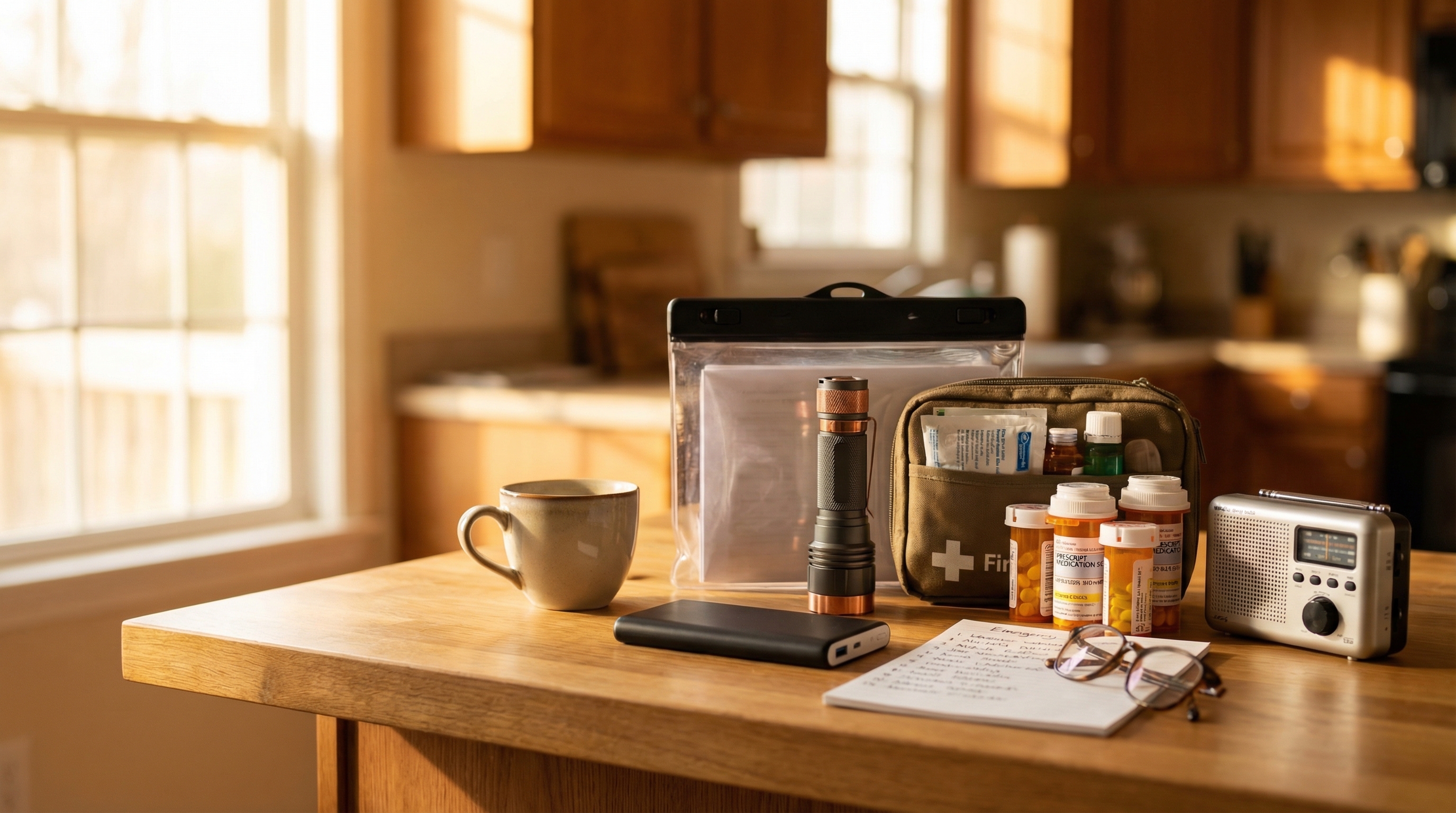
A complete retiree emergency kit should include: 30 days of all medications in original bottles, a written list of all medications, doctors, and pharmacy contacts, copies of insurance policies, wills, and account information in a waterproof container, government IDs and Social Security cards, three to seven days of water and non-perishable food, flashlights with extra batteries, a portable phone charger, thermal emergency blankets, and a go-bag with clothing and medical information clearly tagged. Keep emergency contact numbers (FEMA, Medicare, bank, insurance, family) written down in case digital access is unavailable.
What mental health resources are available during disasters? +
Several resources provide immediate support: the National Suicide Prevention Lifeline (988), the Disaster Distress Helpline (1-800-985-5990), the Veterans Crisis Line (1-800-273-8255, press 1), and Crisis Text Line (text HELLO to 741741). Watch for warning signs including changes in sleep, energy levels, appetite, and feelings of hopelessness or isolation. Recovery is not linear, and seeking help is a sign of strength, not weakness. Local faith communities and organizations like Mental Health America also provide ongoing support.
Related Articles
Quick Topics
Sources
- [1] Internal Revenue Service, Disaster Relief: Retirement Plans and IRAs Under the SECURE 2.0 Act (accessed March 20, 2026)
- [2] Consumer Financial Protection Bureau, Home Equity Lines of Credit (HELOC) Consumer Guide (accessed March 20, 2026)
- [3] Federal Emergency Management Agency, Current FEMA Disaster Declarations and Assistance (accessed March 20, 2026)
- [4] Internal Revenue Service, Tax Relief for Disaster Victims (accessed March 20, 2026)
- [5] Centers for Medicare & Medicaid Services, CMS Resources for Public Health Emergencies (accessed March 20, 2026)
- [6] RX Open, Find Open Pharmacies in Disaster Zones (accessed March 20, 2026)
- [7] Mental Health America, Mental Health Resources for Disaster Recovery (accessed March 20, 2026)
Educational content only. This is not financial, tax, or legal advice. Consult a qualified professional for guidance specific to your situation.